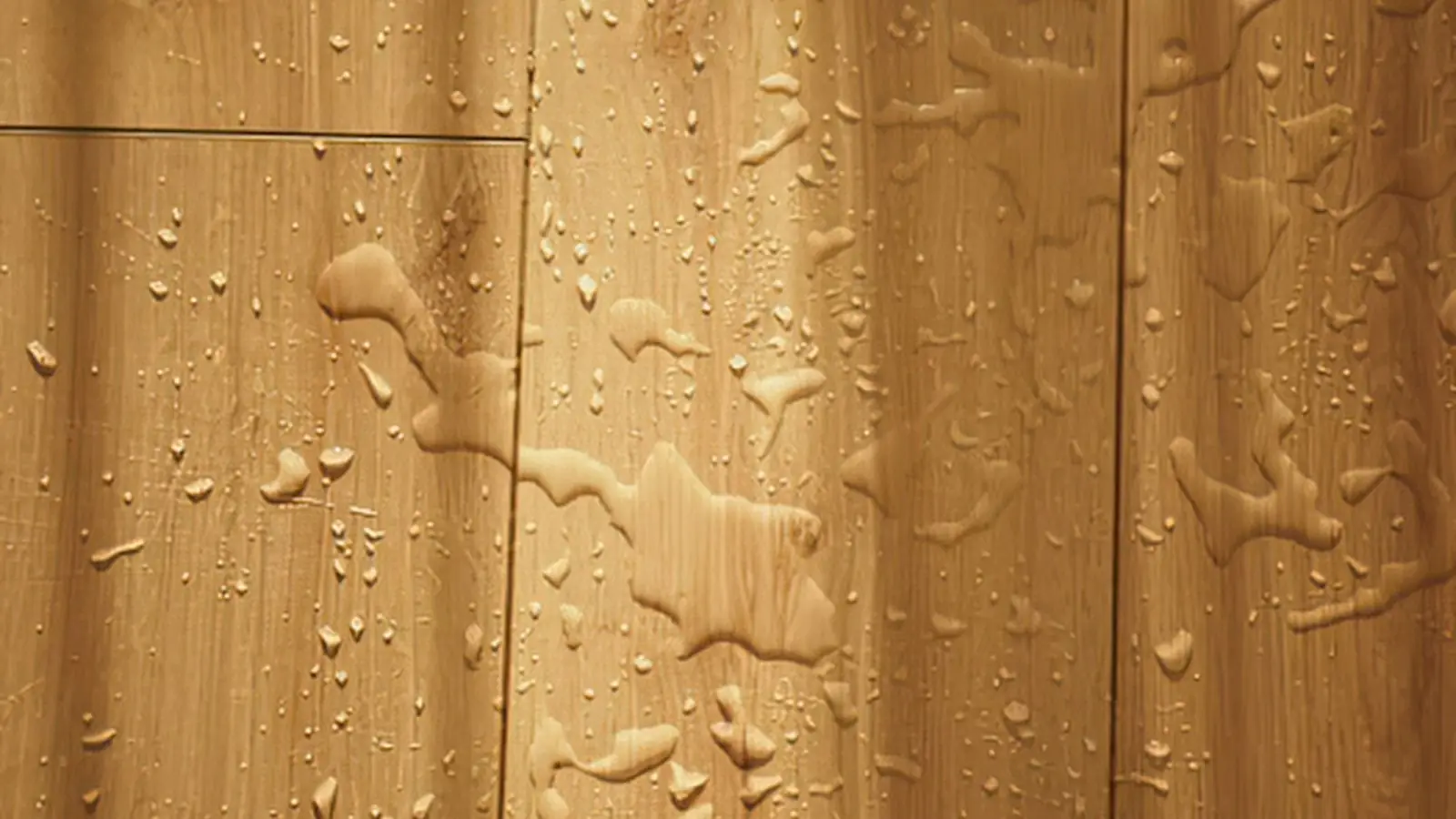
Hardwood takes on water through its underside and edges as well as its top. A dishwasher leak, a supply line or a slab moisture problem can wet the boards for days before the planks start to lift.
This guide covers the first stage only, which is triage and drying. What you do in the first few days decides how much of the floor is saved, and our emergency water removal line runs 24/7.
Cupping or crowning
Cupping means the edges of each board rise higher than the center, so the board looks like a shallow dish. It usually means the underside is wetter than the top. Crowning is the opposite, with the center higher than the edges.
Crowning often appears after a cupped floor was sanded while still damp, or when the top got wet first. Gaps, buckling and boards lifting off the subfloor are separate and more serious signs. Take photos with a straight edge across the boards.
A quick test is to lay a straightedge across several boards and look for light under it. Check at the same spots over a few days so you can see whether things are getting better or worse. Share the photos with your drying crew.
Call early even when the floor looks fine. A floor that is damp but flat is the easiest to save, because the boards have not yet had time to swell and lock against each other.
Stop the source and protect the floor
Shut off the water at the fixture or the house main, and unplug anything standing in water if you can do so safely. If water is near outlets or the panel, do not go in. Call the utility or 911 before you call us.
Mop up standing water, pull rugs and furniture off the floor, and lift anything with legs that can stain wet wood. Do not put heavy objects on the boards, and do not use a household iron or heat gun to speed things up.
Open the cabinet doors, lift the toe kick and look for a trapped pocket of water. Water hides under dishwashers, refrigerator ice lines and sink bases. Leaving it there keeps feeding the floor.
Why the first days matter
Wet wood swells, and swelling can push boards against each other and lift them. Mold can start on wet organic material within 24 to 48 hours, according to EPA guidance. Every extra day of moisture raises the odds that boards stain, cup permanently or need replacing.
Clean water also does not stay clean. Category 1 water becomes Category 2 or 3 with time and contact, which changes how the floor is handled.
If you can lift a corner of the finish and the board underneath looks dark, the water has gone through. Dark staining that reaches the grain is hard to reverse. Tell the crew what you saw so the plan can reflect it.
Moisture readings tell the story
A moisture meter gives a reading for each area of the floor. Crews check boards, the subfloor underneath and nearby walls, and compare them to a dry reference reading from a part of the house that was not affected.
A thermal imaging camera helps find wet areas under finished surfaces, but it does not give a moisture number. We take readings on day one and again each day until the boards and subfloor reach a dry standard.
Readings also tell you when to stop. Running equipment after the floor is dry only costs you power, and shutting it off too soon can leave the subfloor damp. That is why a reading log is part of a good drying job.
Mats, air movers and dehumidifiers
Floor drying mats sit over the boards and pull moisture out of them. Often a small hole is made in a wall cavity or a few boards are removed so air can reach the space under the floor. Air movers push air across the surface and LGR dehumidifiers pull the moisture out of the room.
This is a drying setup that runs for days, not a fan from the garage. A dehumidifier that stays running and a crew that checks readings are what make the difference.
Some floors cannot be dried in place. Glued-down or nail-down floors over a slab, or floors with a finish that seals the top, are slow. In those cases, removing a few boards can open a path for air, and structural drying services can set the plan.
Which boards are saved and which are not
Solid hardwood that was wet briefly and dried fast is often saved, and cupping can settle back as the moisture drops. Floors that stayed wet for a long time, or that were wet by sewage or dirty water, are much less likely to survive.
Engineered flooring and laminate are another matter, because their layers can separate and do not recover. Wait for dry readings before deciding on anything permanent, because many floors flatten more than you expect.
You will not know the final answer on day one. Dry first, wait for the boards to settle and then decide with a flooring contractor. A floor that looks bad at the start often looks fine after drying.
Dry air, closed houses and your floor
Thermal has a desert climate, with very hot summers and mild winters. Dry outdoor air does not mean a wet floor dries safely, since a closed house with the AC running holds moisture in the floor. Start drying equipment right away and do not wait for the weather to do the work.
As a general physical fact, wood gives up moisture to dry air and shrinks. A floor that was swollen can end up with gaps between boards after it dries, and that is another reason to dry steadily and not too fast. If you are nearer Coachella or Mecca, our Coachella team and Mecca-area crews answer the same line.
Repair questions Thermal homeowners ask
Sometimes, once the moisture content drops and the boards even out. Do not sand or refinish until the floor and subfloor read dry. Sanding too early can leave crowning.
Fans move air but do not remove moisture from the room, and they will not pull water from under the boards. A professional setup uses mats, air movers and dehumidifiers with daily readings.
Sudden and accidental damage is often covered. Gradual leaks and neglect often are not, and flood is usually excluded. Check your policy and ask your insurer.
Wood loses moisture to dry air and shrinks, so gaps can show after a floor dries. That is general physics and it varies by species and board width. Gaps that appear after drying are one thing to ask about during repair.