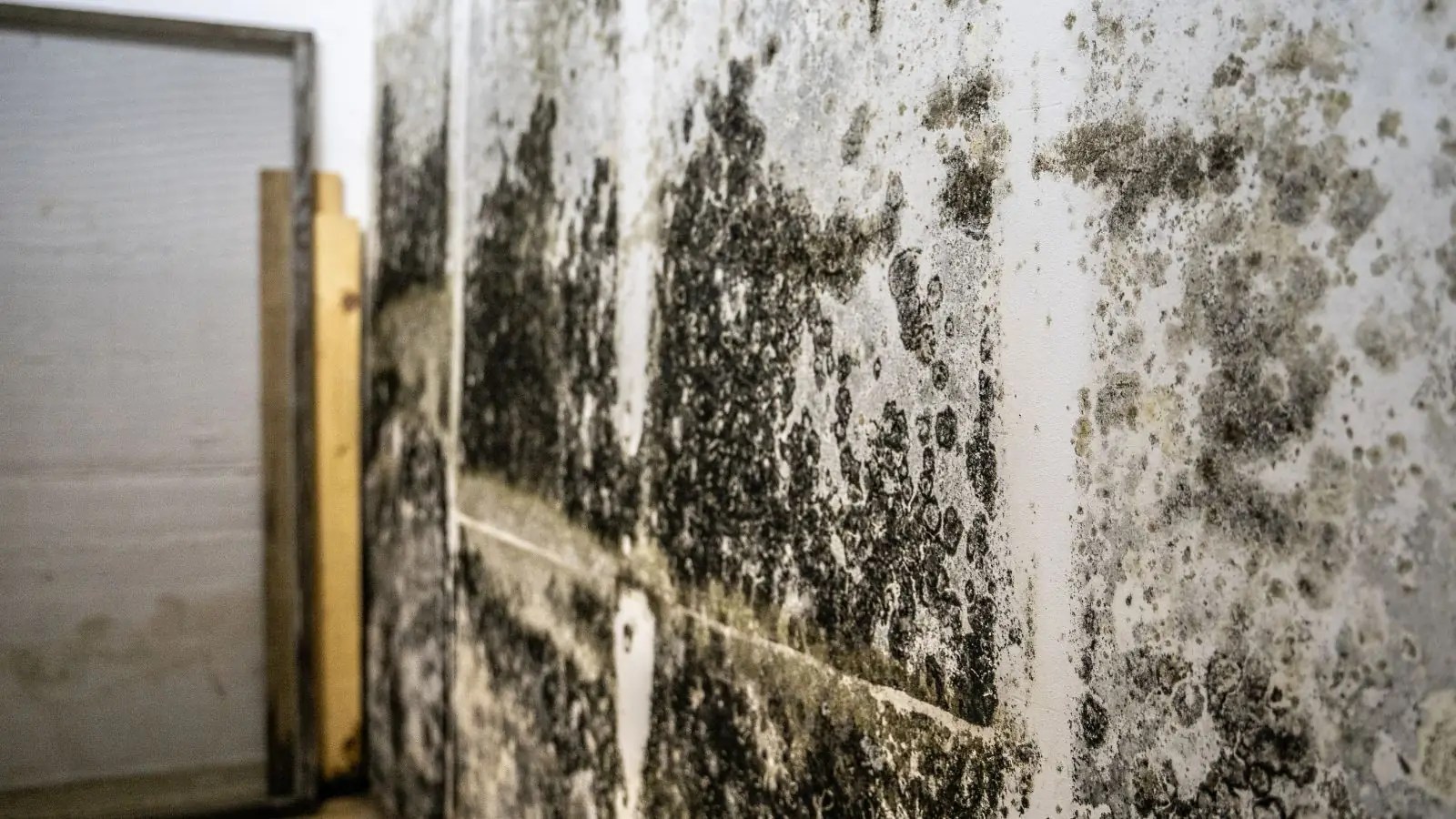
Most homes in the eastern Coachella Valley have no basement at all, so let us define the term. This guide covers any wall below grade or on the lowest level: a cellar, a sunken room, a half-buried storage space, or a garage wall that sits against soil or a planter.
If a wall like that has dark growth, a musty smell or a damp patch, the steps are the same. You deal with the water first and the surface second, and you use a mold remediation process that matches the wall material instead of a bottle of bleach.
Why masonry is not drywall
Drywall has a paper face that mold can feed on, and when it stays wet it usually has to be cut out. Concrete and block do not work that way. They are mineral, so they do not feed growth themselves, but they are porous and pull water in like a sponge.
That means mold on masonry lives in dust, paint, sealer, stored cardboard and the film left on the surface. It also means the wall can stay damp deep inside long after the face looks dry. A wall that feels dry to the hand can still read wet on a moisture meter.
White crust or mold? Check before you scrub
Efflorescence is a white, chalky or crystalline deposit left when water carries dissolved salts through masonry and evaporates at the surface. It is not mold. It often shows up on block and poured concrete, and it is a strong sign that water is moving through the wall.
A few clues help. Efflorescence is dry, powdery and brushes off, while mold tends to look fuzzy, spotted or smeared, in green, black or grey, and often smells earthy. You cannot confirm either by eye alone, so treat any doubt as a reason to have the wall looked at.
Black staining on masonry is not always mold either, since soot, dirt and old water marks can look the same. That is one reason a trained eye and a moisture meter beat a guess.
- Powdery white crust that dries to dust: likely salts
- Dark or colored spots that smear when wiped: possibly growth
- Both on the same wall: water is clearly present, so find it
Find the moisture source first
Cleaning a wall without fixing the water is a short-term cosmetic job. Look for a leaking supply or drain line in or behind the wall, a hose bib or irrigation line outside, a planter or flower bed piled against the exterior, a gutter or roof drain dumping at the foundation, and water standing near the wall after rain.
Plumbing leaks are the easiest to prove. Shut the water off at the house main for an hour and see whether a wet patch stops spreading. If it does, call a plumber, and then call us for water mitigation and drying of what got wet.
Also look at the room itself. Stored boxes against the wall, a dehumidifier that has not been emptied, a clothes dryer vented into the space and a bathroom fan that ends inside a wall all add moisture. These sources are easy to fix, and they matter as much as a pipe.
Framed walls in a below-grade room or garage
Some lower-level rooms have a stud wall built inside the masonry shell, with insulation and drywall on the room side. Moisture gets trapped in the gap, and growth can spread on the back of the drywall and on the bottom plate while the room side looks fine.
Here the answer is often to remove the damp drywall and insulation, let the masonry and framing dry, and then rebuild. Solid framing lumber can usually be cleaned and dried. Wet insulation and paper-faced board are usually discarded.
What removal actually looks like
Work follows ANSI/IICRC S520, the standard for mold remediation. The crew sets up containment with plastic sheeting, runs a HEPA air scrubber and negative air so dust does not travel, and removes porous material that cannot be cleaned.
On masonry the surface is HEPA vacuumed, damp wiped or wire brushed as the material allows, and then vacuumed again. Dehumidifiers and air movers dry the wall, and a moisture meter confirms it is dry before anything is closed up or painted. If a sale or loan is involved, independent clearance testing exists, and lenders set their own rules.
Plan for the rebuild too. Once the wall reads dry, trim, paint and any new board go back on. A breathable masonry paint or a plain coat of primer suits better than a thick film that traps water behind it.
What restoration will not do
We are a restoration company, not a waterproofing or foundation repair contractor. We can remove growth, dry the wall and rebuild finishes. We do not install drainage, seal foundations or fix cracks that let water in.
If the source is groundwater seeping through the wall or floor, you will need a licensed contractor who does that kind of work. Ask which licenses cover the job and check them on the California Contractors State License Board site. Painting over damp masonry without fixing the water only hides the problem for a while.
Low ground and runoff channels near Thermal
Thermal sits roughly 25 miles southeast of Palm Springs and about 9 to 10 miles north of the Salton Sea, and the land here is below sea level. For a low wall, that is a reason to look at where water goes before you blame the wall.
A Coachella Valley stormwater channel project reach is named for the Thermal Drop Structure, so storm runoff channels run through this area toward the Salton Sea. After a hard rain, check low walls and garage slabs within a day, and photograph anything damp for your records. If you are closer to Coachella, the Coachella crews cover the same hours, and Indio homeowners can call the same number.
Mold questions from Thermal homeowners
No. Paint hides the surface but does not remove growth or dry the wall. If moisture is still moving through the block, the paint will usually bubble or peel and the spots return.
Bleach is not a substitute for removal and it adds more water to a porous wall. Physical removal with HEPA vacuuming and drying is the approach the S520 standard follows. For health questions about exposure, ask your physician.
Drying usually takes several days, and thick block or poured concrete can take longer than drywall. A moisture meter, not the look or feel of the wall, tells you when it is done.
They can. Low ground, irrigation runoff and storm channels all put water near foundations in the eastern valley. The practical step is to check grading, planters and drains near any wall that keeps turning damp.