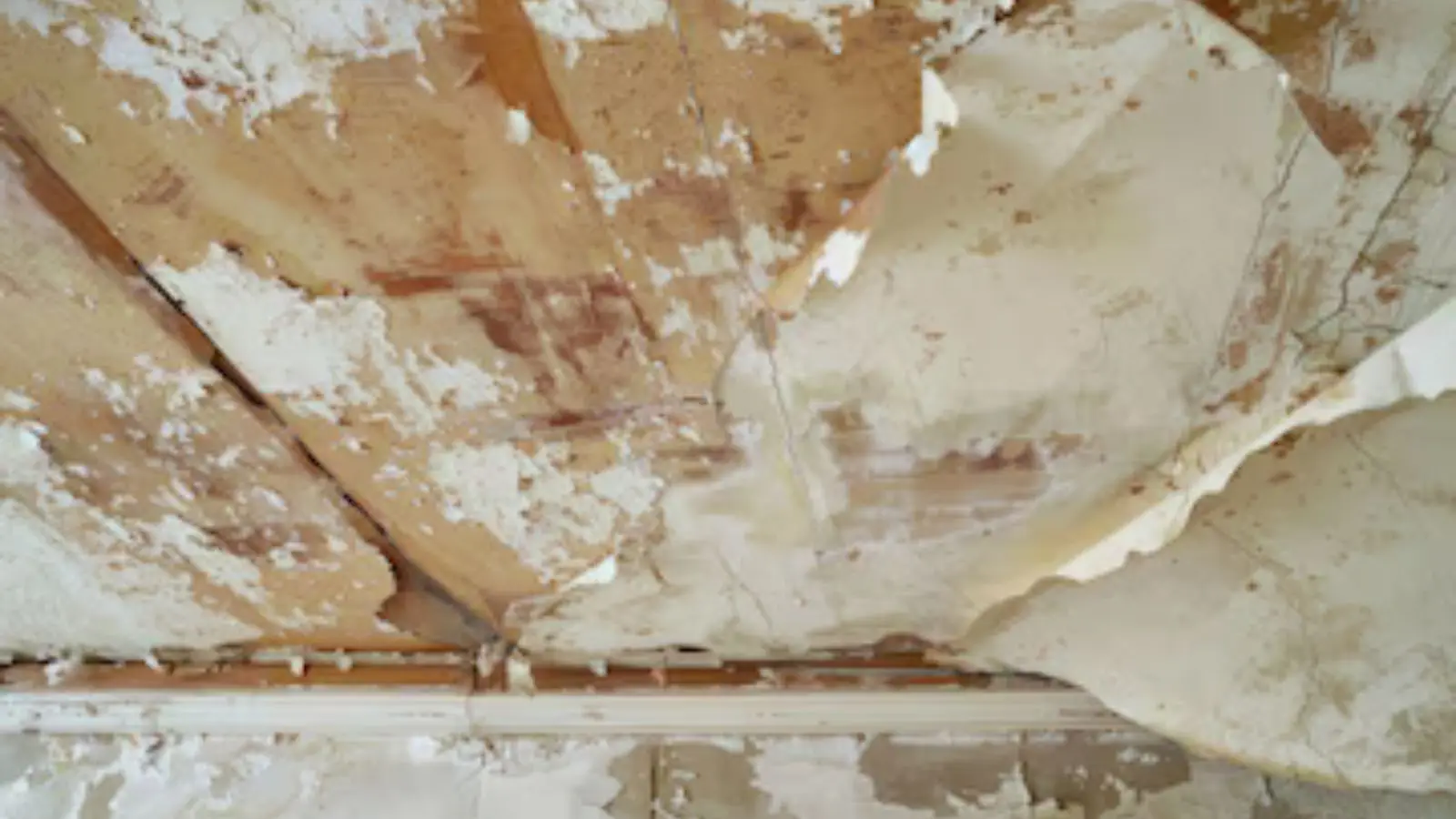
Water damage rarely announces itself with a flood. More often it shows up as a faint stain, a smell you cannot place, or a floor that has started to curl at the edges.
This guide runs from the first obvious sign to the damage you cannot see. If something below matches what you have, a water mitigation crew can check it with instruments rather than guesses.
Signs you can see
Ceiling stains are the classic one. They start as a pale yellow or tan ring, and the ring grows and darkens each time the leak runs. Paint that bubbles, blisters or peels is another sign, since moisture is pushing the coating off the wall from behind.
Look also for baseboards that have swollen or pulled away from the wall. Drywall seams that begin to show and a dark line along the bottom of a wall are further clues.
Rust stains near fixtures, discoloured grout and cracked tile edges can also point to repeated wetting. Window sills with swollen wood or peeling finish sometimes show water entering from outside.
Signs you can feel
Touch tells you things your eyes miss. Drywall that is soft, cool and damp, or oddly warm and clammy, may be holding water. Floors that feel springy underfoot can mean the subfloor is wet.
Hardwood that cups, with edges higher than centres, is reacting to moisture from below. Laminate that lifts at the seams does the same.
Carpet that feels damp in one spot while the rest is dry may sit over a leak. Press with your hand, not your knee, and look for wet pad underneath.
Windows and doors that suddenly stick can be a hint too, since wet framing swells. In a dry climate this is easy to blame on the heat, so check for moisture before you adjust the hardware.
Signs you can smell
A musty smell means something is damp and has been for a while. It often shows up before any stain. The smell can be stronger in the morning or when the air conditioner starts, since the system moves air past the damp spot.
A sewer smell is different and needs a different response. Stay out of the area and do not use that drain until it is checked.
Do not mask the odour with sprays. The smell is information, and covering it only delays finding the cause.
The quick reference
The table sorts the common signs by what they usually mean. It is a starting point, not a diagnosis.
If two or more signs appear in the same room, treat the situation as more urgent. Signs that stack tend to mean water has been present for a while.
| Sign | What it usually means | What to do next |
|---|---|---|
| Ceiling stain with a ring | Water has passed through the ceiling from above | Shut off nearby water, photograph it and have the area checked |
| Bubbling or peeling paint | Moisture behind the wall surface | Check for a source and have the wall read with a moisture meter |
| Cupped or lifting floor | Moisture under or inside the flooring | Stop the source and call for drying before the boards settle |
| Musty smell | Hidden damp material, often for some time | Look for the source and have hidden areas scanned |
| Soft or warm drywall | Wet drywall, sometimes from a hidden line | Do not press hard, shut the water off and call |
| Water bill creeping up | A leak you have not found | Check the meter with all fixtures off and look at hidden runs |
Leaks that hide behind cool walls
In a hot dry climate, a wall that feels cool is not always a good sign. Air conditioning lines, drain pans and condensate lines run through attics and wall cavities, and a slow drip from one can soak insulation and drywall with no visible stain for weeks.
A thermal imaging camera finds temperature differences that point to wet material, and a moisture meter confirms it. A cool patch on an otherwise warm wall deserves a second look.
Attic and closet air handlers are common spots, since their drain pans sit above ceilings. A stain on a hallway ceiling beneath one is worth checking right away. Our mold remediation work comes into play only if hidden growth is found afterward.
Rising bills and sounds
A water bill that climbs with no change in habits is a clue. Close every tap, then check whether the meter still moves. If it does, water is going somewhere.
Listen too for hissing in a wall or dripping when everything is off. Those sounds are easy to dismiss and often the first honest warning.
Irrigation lines are another place water hides. A slab leak or a buried line can run for weeks, so notice any warm spots on the floor or unexplained wet soil near the house.
When to call
Call as soon as you see standing water, a spreading stain or a smell that will not clear. Mold can start growing within 24 to 48 hours on wet organic material, so a small sign can get bigger quickly.
If you are near Indio or Coachella, the same dispatch line covers you. If the sign is near electrical equipment, cut power only if the panel is dry and safe to reach.
Photograph what you see before anything is moved. A dated picture shows how the damage developed and helps both the crew and your insurer.
Dry air and low ground in Thermal
Thermal is an unincorporated community in the eastern Coachella Valley, ZIP code 92274. Because the air is so dry, damp walls can look fine on the surface while the cavity stays wet, so a clean-looking wall is not proof of a dry one.
The community sits roughly 25 miles southeast of Palm Springs and about 9 to 10 miles north of the Salton Sea, on land below sea level. When you hunt for a leak, check low corners and door thresholds first.
Cost, claims and warning signs: common questions
No. Only testing following ANSI/IICRC S520 can say, and a physician is the right person for any health question. What you can do is find and stop the moisture.
Not necessarily. A dry stain can mean the leak stopped, or that it only runs sometimes. A moisture meter reading tells you whether the material is still wet.
Evaporating water cools a surface, and AC lines can also chill a wall. A cool, damp patch is worth checking with a thermal imaging camera.
Fresh damage is usually dark and damp, while old damage often leaves rings, rough texture or a dried crust. Only a moisture meter can say whether material is still wet.